Pourquoi 24 pendules se désaccordent puis se réalignent
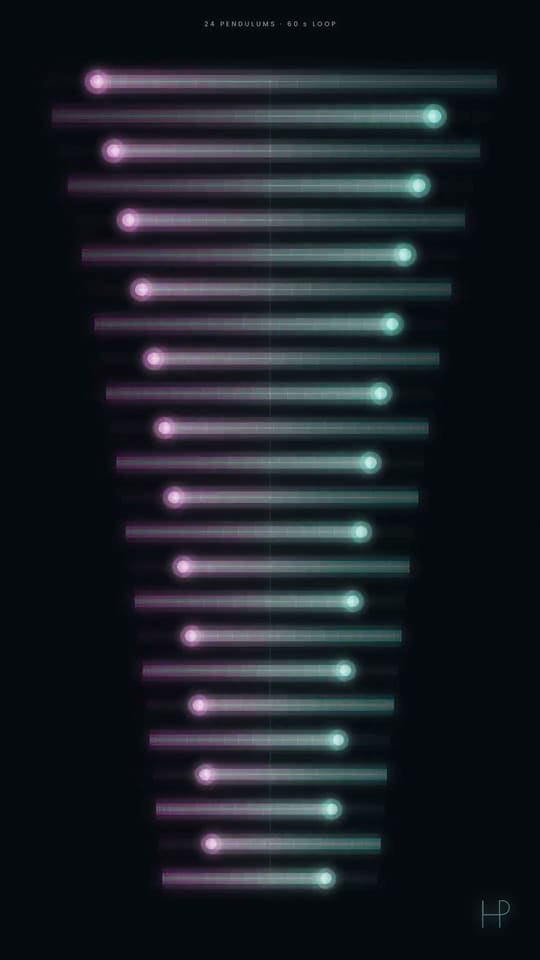
Des pendules de longueurs légèrement différentes se décalent, dessinent des vagues, puis se réalignent.
Lecture depuis YouTube après un clic.
Essaie : change la règle
4,0 s : deux voisins sont décalés de 4,0/60 d’oscillation, et la rangée dessine une vague.
Pourquoi ça marche
Chaque pendule est un peu plus court que le précédent, donc il oscille un peu plus vite. Lancés ensemble, ils se décalent en vagues, en serpents et en chaos apparent, et au bout d’exactement une minute, ils sont tous de nouveau alignés.
Tₙ = 60 s ÷ nLₙ = g · (Tₙ ÷ 2π)²n = 51, 52, … 74
Construis-le toi-même
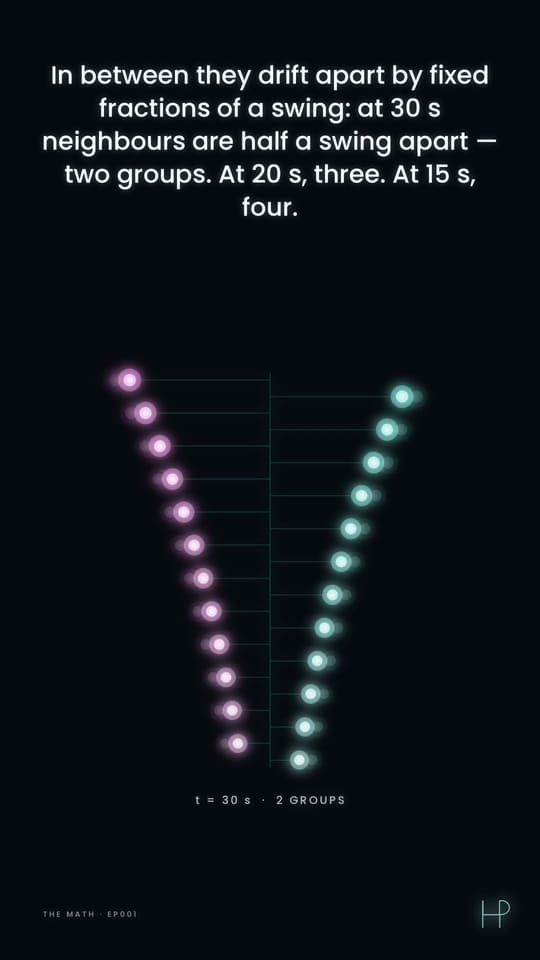
Python 3 · numpy · matplotlibLa rangée de 24 masses à 0, 15, 20 et 30 secondes, et leurs longueurs.
"""Pendulum wave: 24 pendulums making 51, 52, ... 74 swings in 60 seconds.
Run: python pendulum-wave.py   (needs: pip install numpy matplotlib)
"""
import numpy as np
import matplotlib.pyplot as plt

plt.style.use("dark_background")

g, cycle = 9.81, 60.0  # gravity in m/s^2, seconds until they are back in step
n = np.arange(51, 75)  # swings per cycle, one more for each pendulum
period = cycle / n
length = g * (period / (2 * np.pi)) ** 2  # small swings: T = 2 pi sqrt(L / g)
print("lengths in cm:", np.round(length * 100, 1))

fig, axes = plt.subplots(1, 4, figsize=(12, 4), sharey=True)
for ax, t in zip(axes, [0, 15, 20, 30]):
    swing = np.cos(2 * np.pi * t / period)  # where each bob is, from -1 to 1
    ax.scatter(swing, np.arange(len(n)), c=swing, cmap="cool", s=40)
    ax.set_title(f"t = {t} s")
    ax.set_xlim(-1.2, 1.2)
    ax.axis("off")
plt.show()

# Try: t = 60 s (or 75, 80, 90): the same pictures again, as every count is whole
Essaie : Ajoute 60 aux temps : la rangée est de nouveau alignée, comme au départ.
Apprends ce script ligne par ligne, avec des exercices et un quiz → · lance-le dans Google Colab (en anglais) →
Les maths, telles que le film les raconte
Lire les notes du film (de YouTube, en anglais)
Each of the 24 pendulums is slightly shorter than the one before it, tuned so that in one minute the longest completes exactly 51 swings, the next 52, and so on up to 74. Because every count is a whole number, all 24 arrive back at their starting point together at the 60-second mark — perfectly in step. In between, the row drifts apart by fixed fractions of a swing: at 30 s neighbours differ by half a cycle, so odd and even pendulums are exactly opposite (that is the moment the colours split into two groups); at 20 s they form three groups, at 15 s four, and so on.
The travelling "snake" you see is nothing more than those small fractions adding up along the row. The lengths come from the exact period of a real pendulum, T = 4·√(L/g)·K(sin²(θ₀/2)), with K the complete elliptic integral, and the animation integrates the full non-linear equation of motion rather than the small-angle approximation — so the 60-second return is exact, not approximate. Colour is position: teal on one side of centre, pink on the other, white as a bob crosses the middle at full speed.
The second minute shows the very same motion while the camera rises to a bird's-eye view.
D’après la description de 24 Pendulums Fall Out of Sync (en anglais).