Warum 24 Pendel aus dem Takt geraten und wieder einrasten
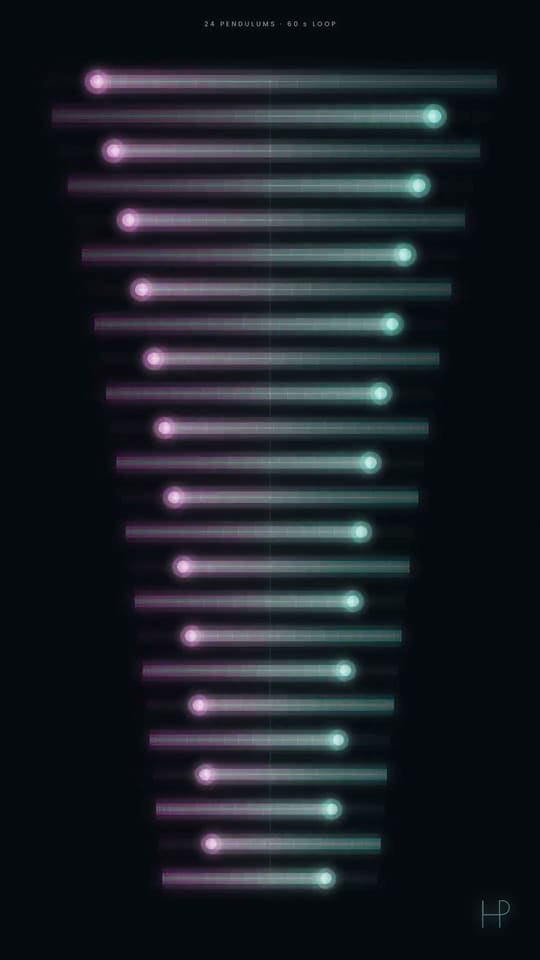
Pendel mit leicht verschiedenen Längen geraten aus dem Takt, zeichnen Wellen und finden wieder in eine Linie.
Läuft nach einem Klick von YouTube.
Probier es aus: Ändere die Regel
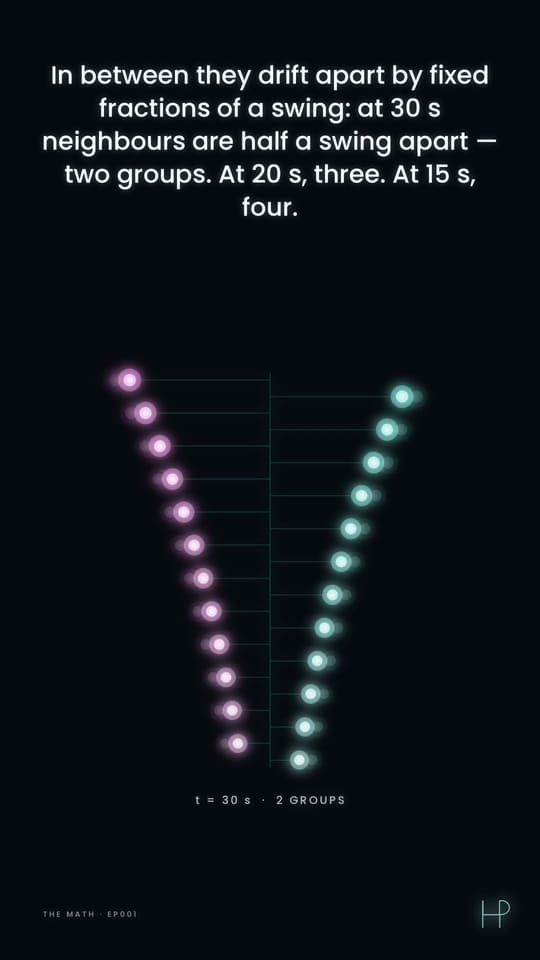
4,0 s: Nachbarn liegen 4,0/60 einer Schwingung auseinander, und die Reihe zeichnet eine Welle.
Warum es funktioniert
Jedes Pendel ist etwas kürzer als das vorige, also schwingt es etwas schneller. Zusammen gestartet, laufen sie in Wellen, Schlangen und scheinbares Chaos auseinander, und nach genau einer Minute sind alle wieder im Takt.
Tₙ = 60 s ÷ nLₙ = g · (Tₙ ÷ 2π)²n = 51, 52, … 74
Bau es selbst
Python 3 · numpy · matplotlibDie Reihe der 24 Pendelkörper bei 0, 15, 20 und 30 Sekunden, und ihre Längen.
"""Pendulum wave: 24 pendulums making 51, 52, ... 74 swings in 60 seconds.
Run: python pendulum-wave.py   (needs: pip install numpy matplotlib)
"""
import numpy as np
import matplotlib.pyplot as plt

plt.style.use("dark_background")

g, cycle = 9.81, 60.0  # gravity in m/s^2, seconds until they are back in step
n = np.arange(51, 75)  # swings per cycle, one more for each pendulum
period = cycle / n
length = g * (period / (2 * np.pi)) ** 2  # small swings: T = 2 pi sqrt(L / g)
print("lengths in cm:", np.round(length * 100, 1))

fig, axes = plt.subplots(1, 4, figsize=(12, 4), sharey=True)
for ax, t in zip(axes, [0, 15, 20, 30]):
    swing = np.cos(2 * np.pi * t / period)  # where each bob is, from -1 to 1
    ax.scatter(swing, np.arange(len(n)), c=swing, cmap="cool", s=40)
    ax.set_title(f"t = {t} s")
    ax.set_xlim(-1.2, 1.2)
    ax.axis("off")
plt.show()

# Try: t = 60 s (or 75, 80, 90): the same pictures again, as every count is whole
Probier: Addiere 60 zu den Zeiten: Die Reihe ist wieder in einer Linie, wie am Anfang.
Lerne dieses Skript Zeile für Zeile, mit Übungen und einem Quiz → · starte es in Google Colab (auf Englisch) →
Die Mathematik, wie der Film sie erzählt
Die Notizen zum Film lesen (von YouTube, auf Englisch)
Each of the 24 pendulums is slightly shorter than the one before it, tuned so that in one minute the longest completes exactly 51 swings, the next 52, and so on up to 74. Because every count is a whole number, all 24 arrive back at their starting point together at the 60-second mark — perfectly in step. In between, the row drifts apart by fixed fractions of a swing: at 30 s neighbours differ by half a cycle, so odd and even pendulums are exactly opposite (that is the moment the colours split into two groups); at 20 s they form three groups, at 15 s four, and so on.
The travelling "snake" you see is nothing more than those small fractions adding up along the row. The lengths come from the exact period of a real pendulum, T = 4·√(L/g)·K(sin²(θ₀/2)), with K the complete elliptic integral, and the animation integrates the full non-linear equation of motion rather than the small-angle approximation — so the 60-second return is exact, not approximate. Colour is position: teal on one side of centre, pink on the other, white as a bob crosses the middle at full speed.
The second minute shows the very same motion while the camera rises to a bird's-eye view.
Aus der Beschreibung von 24 Pendulums Fall Out of Sync (auf Englisch).