진자 24개는 왜 박자가 어긋났다가 다시 맞춰질까
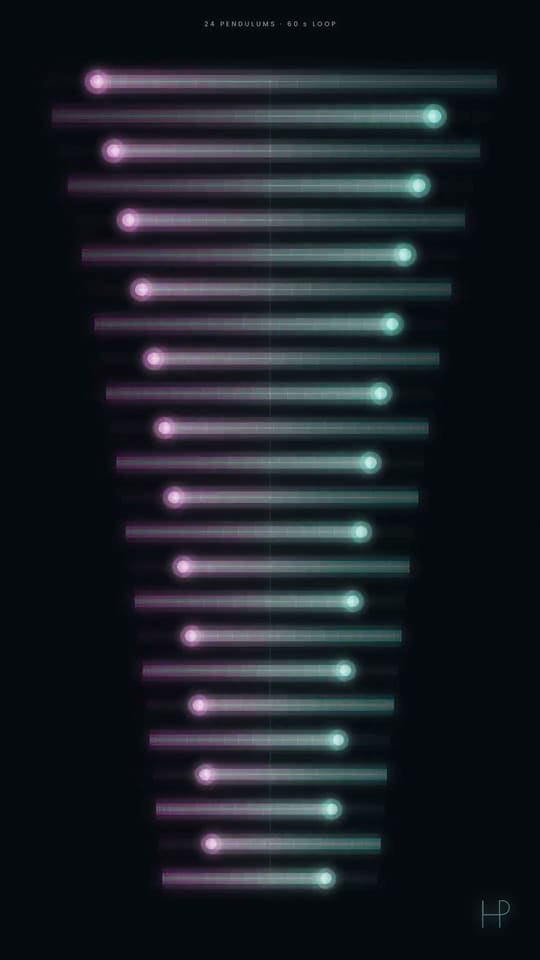
길이가 조금씩 다른 진자들이 박자가 어긋나며 파동을 그리다가, 다시 한 줄로 돌아와요.
클릭하면 YouTube에서 재생돼요.
해 보기: 규칙을 바꿔 보세요
4.0초: 이웃끼리 4.0/60 왕복 차이가 나고, 줄이 파동을 그려요.
왜 이렇게 될까
진자마다 앞 진자보다 조금 짧아서 조금 더 빨리 흔들려요. 함께 출발한 진자들은 파동, 뱀 모양, 혼돈처럼 보이는 모습으로 흩어졌다가, 정확히 1분 뒤 모두 다시 박자를 맞춰요.
Tₙ = 60 s ÷ nLₙ = g · (Tₙ ÷ 2π)²n = 51, 52, … 74
직접 만들기
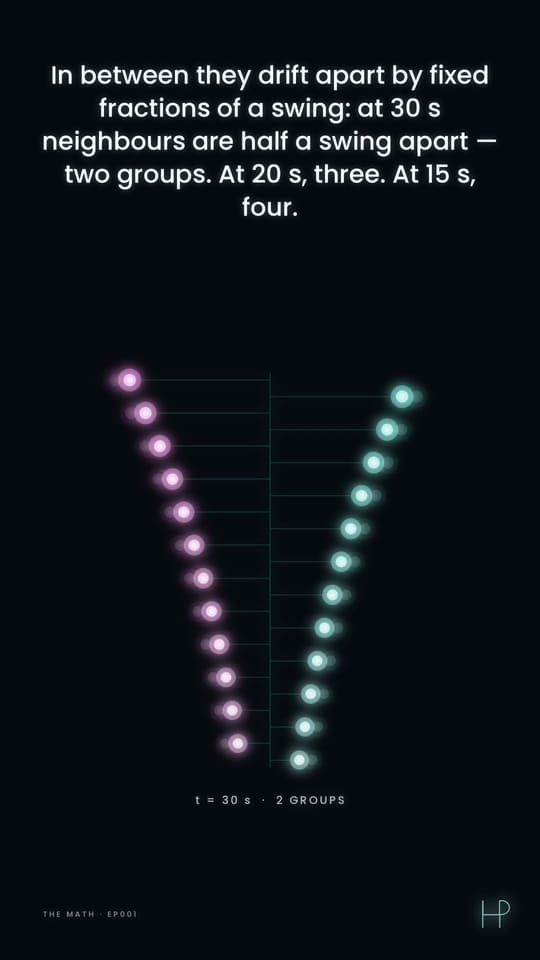
Python 3 · numpy · matplotlib0초, 15초, 20초, 30초일 때 추 24개의 줄과 진자들의 길이.
"""Pendulum wave: 24 pendulums making 51, 52, ... 74 swings in 60 seconds.
Run: python pendulum-wave.py   (needs: pip install numpy matplotlib)
"""
import numpy as np
import matplotlib.pyplot as plt

plt.style.use("dark_background")

g, cycle = 9.81, 60.0  # gravity in m/s^2, seconds until they are back in step
n = np.arange(51, 75)  # swings per cycle, one more for each pendulum
period = cycle / n
length = g * (period / (2 * np.pi)) ** 2  # small swings: T = 2 pi sqrt(L / g)
print("lengths in cm:", np.round(length * 100, 1))

fig, axes = plt.subplots(1, 4, figsize=(12, 4), sharey=True)
for ax, t in zip(axes, [0, 15, 20, 30]):
    swing = np.cos(2 * np.pi * t / period)  # where each bob is, from -1 to 1
    ax.scatter(swing, np.arange(len(n)), c=swing, cmap="cool", s=40)
    ax.set_title(f"t = {t} s")
    ax.set_xlim(-1.2, 1.2)
    ax.axis("off")
plt.show()

# Try: t = 60 s (or 75, 80, 90): the same pictures again, as every count is whole
해 보기: 시간에 60을 더해 보세요. 처음처럼 줄이 다시 한 줄로 서요.
영상이 들려주는 수학
영상 노트 보기 (YouTube에서, 영어)
Each of the 24 pendulums is slightly shorter than the one before it, tuned so that in one minute the longest completes exactly 51 swings, the next 52, and so on up to 74. Because every count is a whole number, all 24 arrive back at their starting point together at the 60-second mark — perfectly in step. In between, the row drifts apart by fixed fractions of a swing: at 30 s neighbours differ by half a cycle, so odd and even pendulums are exactly opposite (that is the moment the colours split into two groups); at 20 s they form three groups, at 15 s four, and so on.
The travelling "snake" you see is nothing more than those small fractions adding up along the row. The lengths come from the exact period of a real pendulum, T = 4·√(L/g)·K(sin²(θ₀/2)), with K the complete elliptic integral, and the animation integrates the full non-linear equation of motion rather than the small-angle approximation — so the 60-second return is exact, not approximate. Colour is position: teal on one side of centre, pink on the other, white as a bob crosses the middle at full speed.
The second minute shows the very same motion while the camera rises to a bird's-eye view.
출처: 다음 영상의 설명 Pendulum Wave: 24 Pendulums Fall Out of Sync, Then Snap Back (영어).