Dlaczego 24 wahadła rozchodzą się i wracają do linii
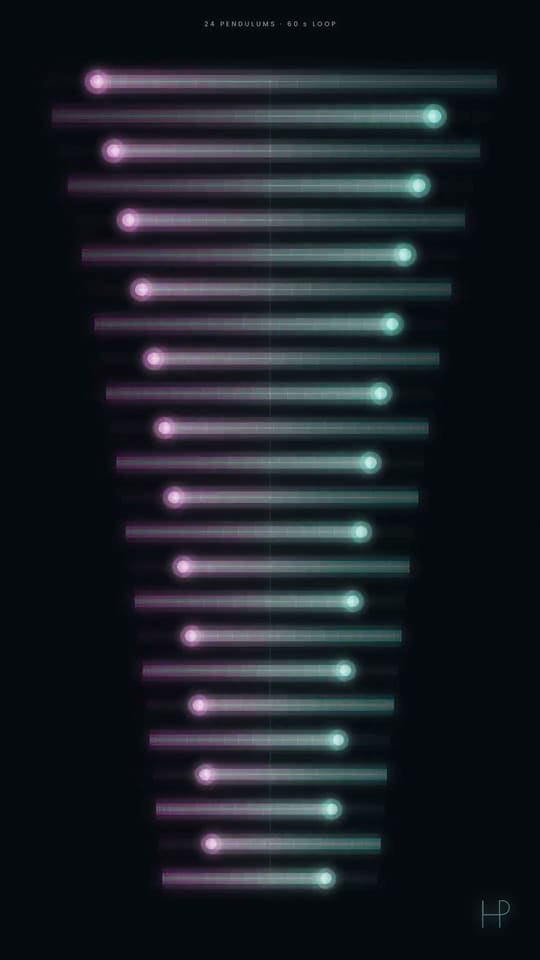
Wahadła o nieco innych długościach rozchodzą się w rytmie, rysują fale i wracają do jednej linii.
Film gra z YouTube po kliknięciu.
Spróbuj: zmień regułę
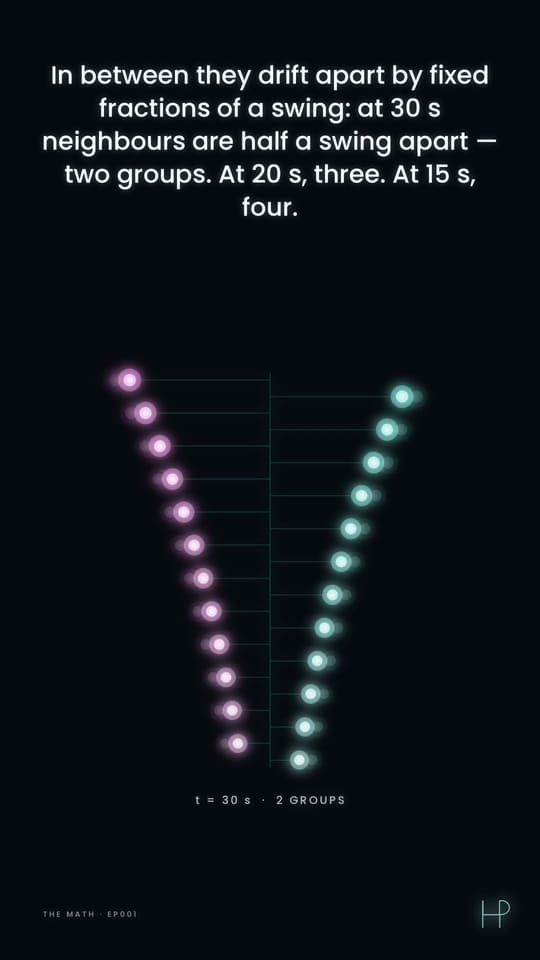
4,0 s: sąsiednie wahadła dzieli 4,0/60 wahnięcia, a rząd rysuje falę.
Dlaczego to działa
Każde wahadło jest trochę krótsze od poprzedniego, więc waha się trochę szybciej. Puszczone razem rozchodzą się w fale, węże i pozorny chaos, a po dokładnie jednej minucie wszystkie są znów w jednej linii.
Tₙ = 60 s ÷ nLₙ = g · (Tₙ ÷ 2π)²n = 51, 52, … 74
Zbuduj to w Pythonie
Python 3 · numpy · matplotlibRząd 24 ciężarków po 0, 15, 20 i 30 sekundach oraz ich długości.
"""Pendulum wave: 24 pendulums making 51, 52, ... 74 swings in 60 seconds.
Run: python pendulum-wave.py   (needs: pip install numpy matplotlib)
"""
import numpy as np
import matplotlib.pyplot as plt

plt.style.use("dark_background")

g, cycle = 9.81, 60.0  # gravity in m/s^2, seconds until they are back in step
n = np.arange(51, 75)  # swings per cycle, one more for each pendulum
period = cycle / n
length = g * (period / (2 * np.pi)) ** 2  # small swings: T = 2 pi sqrt(L / g)
print("lengths in cm:", np.round(length * 100, 1))

fig, axes = plt.subplots(1, 4, figsize=(12, 4), sharey=True)
for ax, t in zip(axes, [0, 15, 20, 30]):
    swing = np.cos(2 * np.pi * t / period)  # where each bob is, from -1 to 1
    ax.scatter(swing, np.arange(len(n)), c=swing, cmap="cool", s=40)
    ax.set_title(f"t = {t} s")
    ax.set_xlim(-1.2, 1.2)
    ax.axis("off")
plt.show()

# Try: t = 60 s (or 75, 80, 90): the same pictures again, as every count is whole
Spróbuj: Dodaj 60 do czasów: rząd jest z powrotem w jednej linii, jak na starcie.
Poznaj ten skrypt linijka po linijce, z zadaniami i quizem → · uruchom go w Google Colab (po angielsku) →
Matematyka tak, jak opowiada ją film
Pokaż notatki z filmu (z YouTube, po angielsku)
Each of the 24 pendulums is slightly shorter than the one before it, tuned so that in one minute the longest completes exactly 51 swings, the next 52, and so on up to 74. Because every count is a whole number, all 24 arrive back at their starting point together at the 60-second mark — perfectly in step. In between, the row drifts apart by fixed fractions of a swing: at 30 s neighbours differ by half a cycle, so odd and even pendulums are exactly opposite (that is the moment the colours split into two groups); at 20 s they form three groups, at 15 s four, and so on.
The travelling "snake" you see is nothing more than those small fractions adding up along the row. The lengths come from the exact period of a real pendulum, T = 4·√(L/g)·K(sin²(θ₀/2)), with K the complete elliptic integral, and the animation integrates the full non-linear equation of motion rather than the small-angle approximation — so the 60-second return is exact, not approximate. Colour is position: teal on one side of centre, pink on the other, white as a bob crosses the middle at full speed.
The second minute shows the very same motion while the camera rises to a bird's-eye view.
Z opisu filmu 24 Pendulums Fall Out of Sync (po angielsku).