Por qué una multiplicación dibuja un corazón
Une cada punto n con el punto n × k alrededor de un círculo. Una sola multiplicación dibuja una cardioide y sus primas.
Se reproduce desde YouTube tras hacer clic.
Pruébalo: cambia la regla
Por 2: la cardioide, una cúspide.
Por qué funciona
Pon 200 puntos en un círculo y une cada punto n con el punto n × 2. Cada línea sigue la misma regla, y juntas perfilan una curva en forma de corazón, la cardioide. Cambia el multiplicador y aparece una forma nueva.
punto n → punto (k · n) mod Nk entero → una epicicloide con k − 1 cúspides
Constrúyelo tú
Python 3 · numpy · matplotlib200 puntos, cada uno unido a su doble: la cardioide.
"""Times table on a circle: N dots, each dot n joined to dot (k * n) mod N.
Run: python times-table.py   (needs: pip install numpy matplotlib)
"""
import numpy as np
import matplotlib.pyplot as plt

plt.style.use("dark_background")

N, k = 200, 2  # the number of dots and the multiplier

start = 2 * np.pi * np.arange(N) / N  # dot n at the angle 2*pi*n/N
end = start * k  # dot k*n: angles wrap around the circle by themselves (that is the "mod N")

plt.figure(figsize=(6, 6))
for a, b in zip(start, end):
    plt.plot([np.cos(a), np.cos(b)], [np.sin(a), np.sin(b)], color="#f5c76b", linewidth=0.6)
plt.axis("equal")
plt.axis("off")
plt.show()

# Try: k = 3 for the nephroid, k = 101 to see it collapse into diameters
Prueba: Pon k = 3 para la nefroide, o k = 101 para ver cómo el dibujo se reduce a diámetros.
Aprende este script línea a línea, con ejercicios y un cuestionario → · ejecútalo en Google Colab (en inglés) →
Para docentes: un plan de clase de 45 minutos y una hoja de trabajo en tres niveles →
Las matemáticas, tal como las cuenta el vídeo
Lee las notas del propio vídeo (de YouTube, en inglés)
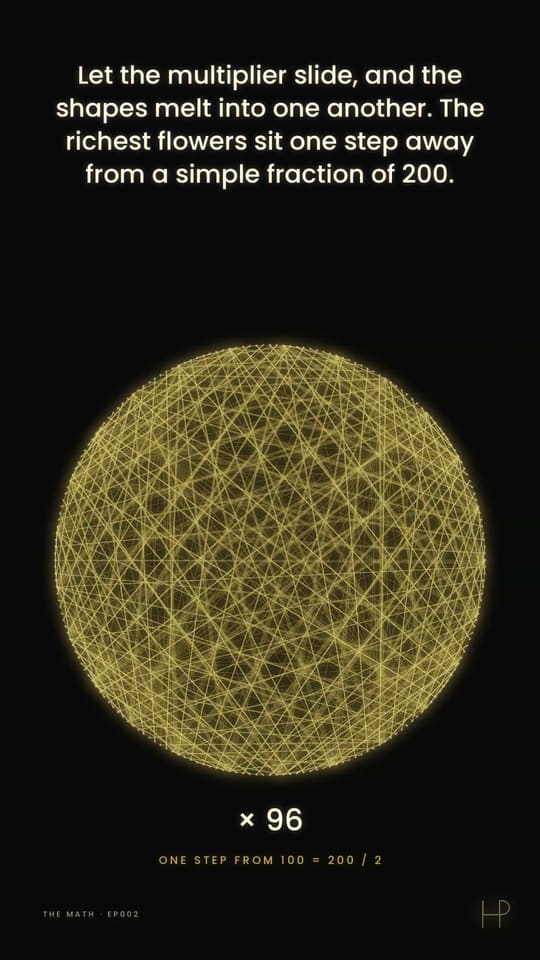
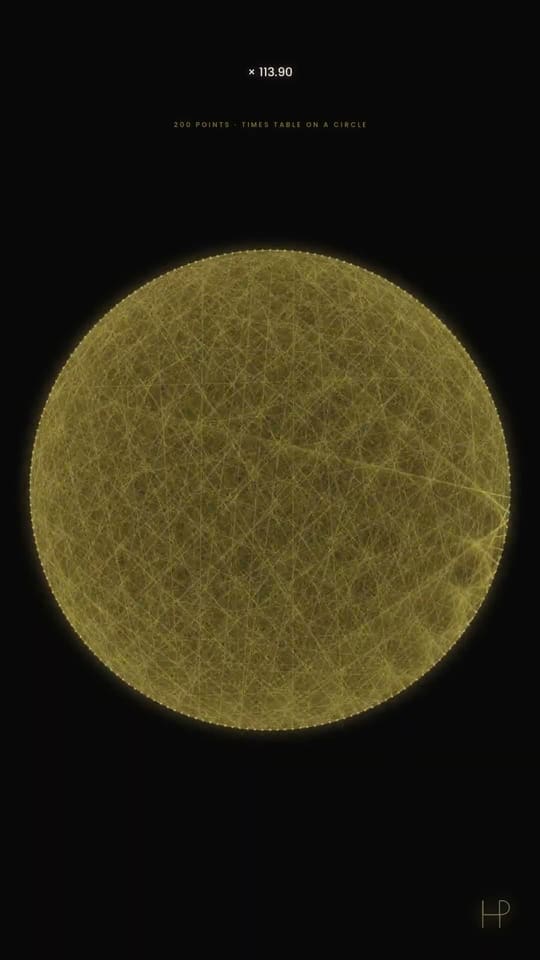
200 points sit evenly around a circle, numbered 0 to 199. One rule draws everything: point n is joined by a straight line to point k·n, counting around the circle and wrapping past 200 (that is k·n mod 200). For k = 2 the envelope of the lines — the curve every one of them just touches — is a cardioid; k = 3 gives a nephroid with two cusps, and in general whole-number k gives an epicycloid with k − 1 cusps. k does not have to be a whole number: the end of each line simply slides along the circle, so the shapes morph into one another as k glides.
The richest flowers appear where k is one away from a simple fraction of 200 (51, 67, 99, 101, 133, 151 …): there the lines almost repeat every few points, and the near-misses pile up into petals. Because only the remainder after dividing by 200 matters, k = 201 sends every point to itself — all 200 lines shrink to nothing — and k = 202 is the cardioid again, exactly where the film began.
De la descripción de One Multiplication Rule Draws Every Shape (en inglés).