Times table on a circle
Join each point n to point n × k around a circle. One multiplication draws a cardioid and its cousins.
Plays from YouTube after a click.
A 3-minute journey through the times table on a circle. Headphones on.
The math
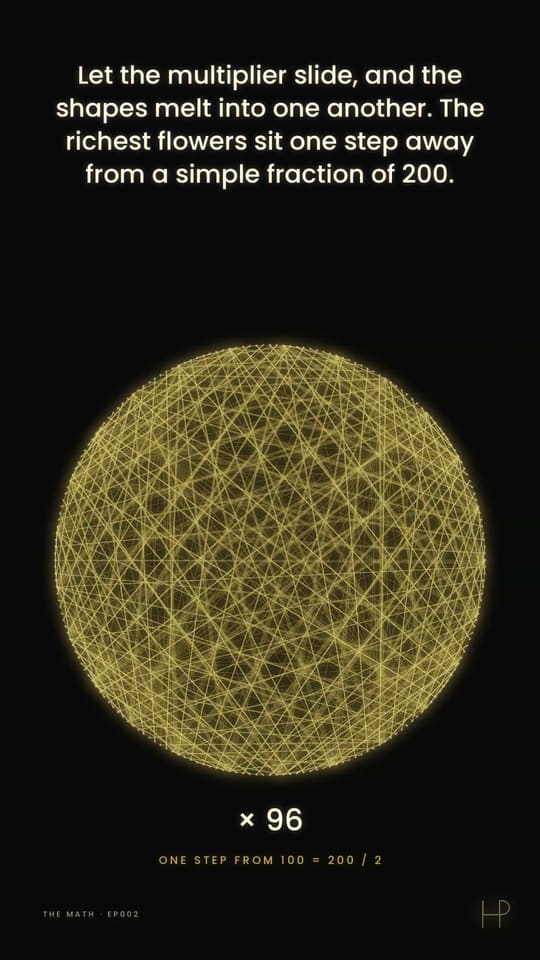
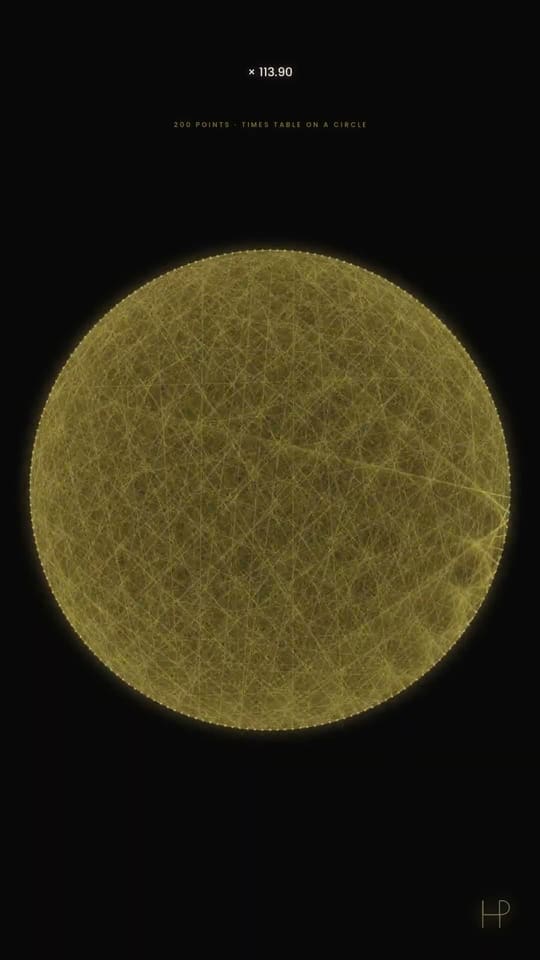
200 points sit evenly around a circle, numbered 0 to 199. One rule draws everything: point n is joined by a straight line to point k·n, counting around the circle and wrapping past 200 (that is k·n mod 200). For k = 2 the envelope of the lines — the curve every one of them just touches — is a cardioid; k = 3 gives a nephroid with two cusps, and in general whole-number k gives an epicycloid with k − 1 cusps. k does not have to be a whole number: the end of each line simply slides along the circle, so the shapes morph into one another as k glides. The richest flowers appear where k is one away from a simple fraction of 200 (51, 67, 99, 101, 133, 151 …): there the lines almost repeat every few points, and the near-misses pile up into petals. Because only the remainder after dividing by 200 matters, k = 201 sends every point to itself — all 200 lines shrink to nothing — and k = 202 is the cardioid again, exactly where the film began.
From the description of One Multiplication Rule Draws Every Shape.