곱셈 하나가 어떻게 하트를 그릴까
원 위의 각 점 n을 점 n × k와 이어요. 곱셈 하나가 카디오이드와 그 친척 곡선들을 그려요.
클릭하면 YouTube에서 재생돼요.
해 보기: 규칙을 바꿔 보세요
2배: 카디오이드, 첨점 하나.
왜 이렇게 될까
원 위에 점 200개를 찍고, 각 점 n을 점 n × 2와 이어요. 선마다 같은 규칙을 따를 뿐인데, 모두 모이면 하트 모양 곡선인 카디오이드의 윤곽이 드러나요. 곱하는 수를 바꾸면 새 모양이 나타나요.
점 n → 점 (k · n) mod N정수 k → 첨점이 k − 1개인 에피사이클로이드
직접 만들기
Python 3 · numpy · matplotlib점 200개, 각 점을 두 배인 점과 연결: 카디오이드.
"""Times table on a circle: N dots, each dot n joined to dot (k * n) mod N.
Run: python times-table.py   (needs: pip install numpy matplotlib)
"""
import numpy as np
import matplotlib.pyplot as plt

plt.style.use("dark_background")

N, k = 200, 2  # the number of dots and the multiplier

start = 2 * np.pi * np.arange(N) / N  # dot n at the angle 2*pi*n/N
end = start * k  # dot k*n: angles wrap around the circle by themselves (that is the "mod N")

plt.figure(figsize=(6, 6))
for a, b in zip(start, end):
    plt.plot([np.cos(a), np.cos(b)], [np.sin(a), np.sin(b)], color="#f5c76b", linewidth=0.6)
plt.axis("equal")
plt.axis("off")
plt.show()

# Try: k = 3 for the nephroid, k = 101 to see it collapse into diameters
해 보기: k = 3으로 바꾸면 네프로이드가, k = 101로 바꾸면 그림이 지름만 남는 모습이 보여요.
이 스크립트를 한 줄씩, 연습 문제와 퀴즈로 배우기 → · Google Colab에서 실행 (영어) →
선생님을 위해: 45분 수업 지도안과 3단계 활동지 →
영상이 들려주는 수학
영상 노트 보기 (YouTube에서, 영어)
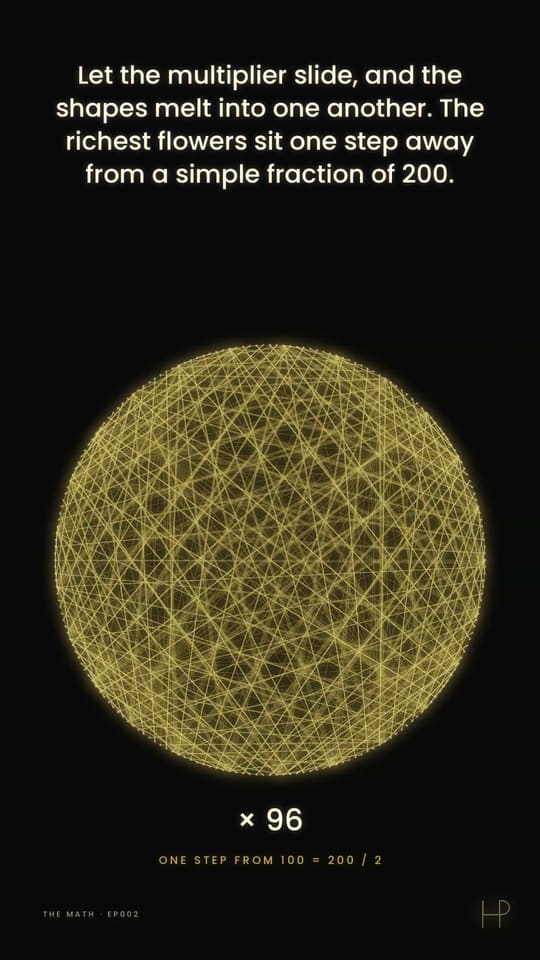
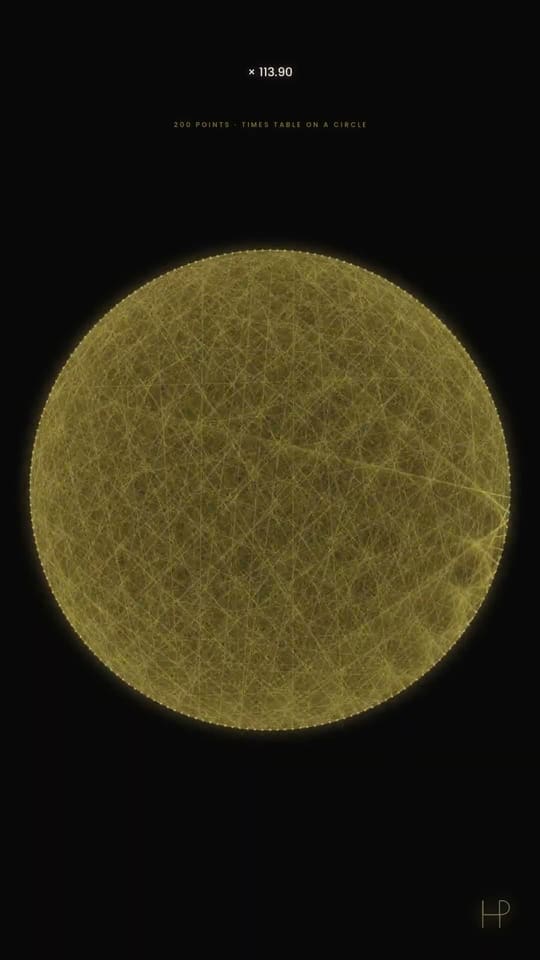
200 points sit evenly around a circle, numbered 0 to 199. One rule draws everything: point n is joined by a straight line to point k·n, counting around the circle and wrapping past 200 (that is k·n mod 200). For k = 2 the envelope of the lines — the curve every one of them just touches — is a cardioid; k = 3 gives a nephroid with two cusps, and in general whole-number k gives an epicycloid with k − 1 cusps. k does not have to be a whole number: the end of each line simply slides along the circle, so the shapes morph into one another as k glides.
The richest flowers appear where k is one away from a simple fraction of 200 (51, 67, 99, 101, 133, 151 …): there the lines almost repeat every few points, and the near-misses pile up into petals. Because only the remainder after dividing by 200 matters, k = 201 sends every point to itself — all 200 lines shrink to nothing — and k = 202 is the cardioid again, exactly where the film began.
출처: 다음 영상의 설명 Times Table on a Circle: One Rule Draws a Heart (Cardioid) (영어).