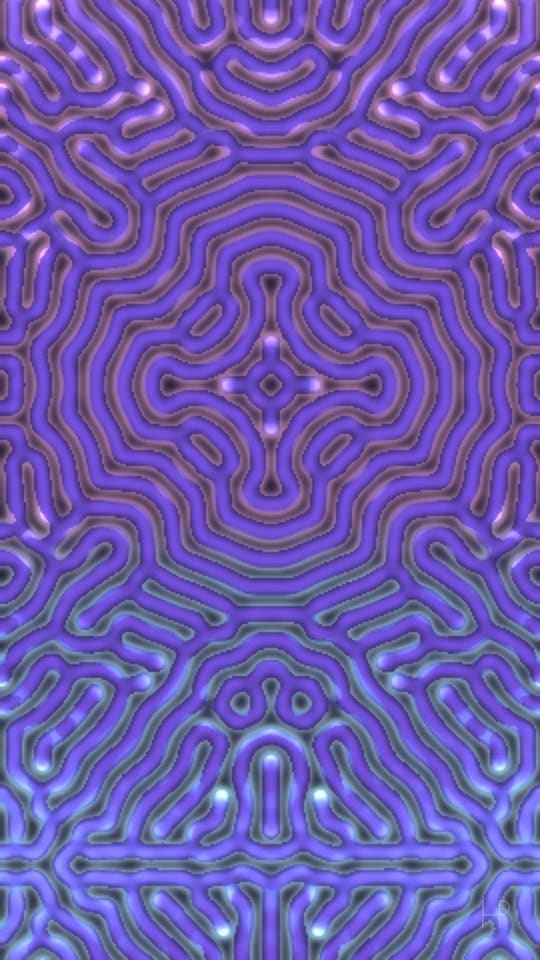
Como duas substâncias fazem crescer manchas e listras
Duas substâncias: uma alimenta, a outra espalha-se. Manchas e listras como as da pele dos animais crescem sozinhas.
É reproduzido a partir do YouTube depois de um clique.
Experimente: mude a regra
0 passos. Toque na placa para adicionar uma gota de B. As mesmas duas equações dão todas as predefinições; só mudam f e k.
Por que razão funciona
Duas substâncias estão na mesma placa. Uma é alimento, a outra consome-a para fazer mais de si mesma, e ambas se espalham. A partir de uma só gota, a segunda cresce sozinha em manchas, listras ou um labirinto, como as marcas na pele de um animal.
∂A/∂t = D_A·∇²A − A·B² + f·(1 − A)∂B/∂t = D_B·∇²B + A·B² − (f + k)·B
Construa-o em Python
Python 3 · numpy · matplotlibUma placa de 128 × 128, seis gotas de B, 6000 passos da regra de Gray–Scott.
"""Turing patterns: the Gray-Scott reaction-diffusion rule on a 128 x 128 grid.
Run: python turing-patterns.py   (needs: pip install numpy matplotlib; takes a few seconds)
"""
import numpy as np
import matplotlib.pyplot as plt

plt.style.use("dark_background")

size, steps = 128, 6000
f, k = 0.0545, 0.062  # feed and kill rates: coral
DA, DB = 1.0, 0.5  # A spreads twice as fast as B

A, B = np.ones((size, size)), np.zeros((size, size))
rng = np.random.default_rng()
for y, x in rng.integers(10, size - 18, (6, 2)):
    B[y : y + 8, x : x + 8] = 1.0  # six drops of B


def laplacian(Z):
    """Each cell against its neighbours: 0.2 for the four sides, 0.05 for the corners (Karl Sims)"""
    sides = np.roll(Z, 1, 0) + np.roll(Z, -1, 0) + np.roll(Z, 1, 1) + np.roll(Z, -1, 1)
    corners = (np.roll(np.roll(Z, 1, 0), 1, 1) + np.roll(np.roll(Z, 1, 0), -1, 1)
               + np.roll(np.roll(Z, -1, 0), 1, 1) + np.roll(np.roll(Z, -1, 0), -1, 1))
    return 0.2 * sides + 0.05 * corners - Z


for _ in range(steps):
    reaction = A * B * B  # one A and two B make three B
    A += DA * laplacian(A) - reaction + f * (1 - A)
    B += DB * laplacian(B) + reaction - (f + k) * B

plt.figure(figsize=(6, 6))
plt.imshow(B, cmap="magma", vmin=0, vmax=0.5)
plt.axis("off")
plt.show()

# Try: f, k = 0.039, 0.058 (a cell net) or 0.034, 0.063 (spots) -> the same rule, another pattern
Experimente: Experimente f, k = 0.039, 0.058 para uma rede de células ou 0.034, 0.063 para manchas: a mesma regra, outra espécie.
Aprenda este script linha a linha, com exercícios e um quiz → · execute-o no Google Colab (em inglês) →
A matemática, tal como o filme a conta
Ler as notas do próprio filme (do YouTube, em inglês)
Two chemicals share a dish. A is food, fed in everywhere at a slow rate; B eats A to make more of itself (two B's plus one A give three B's) and is removed at a fixed rate. Both spread by diffusion, but A spreads twice as fast as B.
That one asymmetry is the whole secret: Alan Turing showed in 1952 that a "fast inhibitor, slow activator" pair turns a uniform dish unstable, so that the tiniest speck of B grows into a pattern with a built-in wavelength — spots, stripes, labyrinths, cells. The equations here are the Gray–Scott model, and only two numbers change during the film: the feed rate f and the kill rate k. Every "new species" you see is the same rule with those two dials moved a little: coral (f 0.029, k 0.057), solitons that split and travel (0.030, 0.060), a cell net (0.039, 0.058), turbulence (0.026, 0.051).
Colour is age: fresh growth fronts are pink-white, mature tissue violet, old regions indigo; the second seed carries a cyan tint so you can see where the two fronts meet. In the finale the dish is wiped and reseeded inside the shape of the channel's monogram — the same rule, confined — and then the walls are removed. These are the equations behind leopard spots, zebra stripes and the ridges on your fingertips.
Da descrição de Two Chemicals Grow a Living Pattern (em inglês).