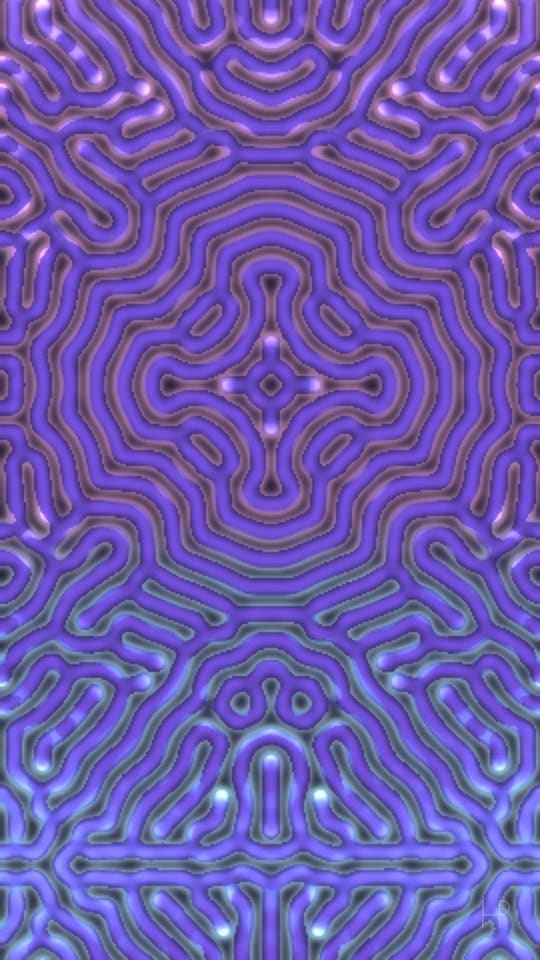
Turing patterns
Two chemicals: one feeds, one spreads. Spots and stripes like animal skin grow on their own.
Plays from YouTube after a click.
A 2½-minute journey through reaction–diffusion. Headphones on.
The math
Two chemicals share a dish. A is food, fed in everywhere at a slow rate; B eats A to make more of itself (two B's plus one A give three B's) and is removed at a fixed rate. Both spread by diffusion, but A spreads twice as fast as B. That one asymmetry is the whole secret: Alan Turing showed in 1952 that a "fast inhibitor, slow activator" pair turns a uniform dish unstable, so that the tiniest speck of B grows into a pattern with a built-in wavelength — spots, stripes, labyrinths, cells. The equations here are the Gray–Scott model, and only two numbers change during the film: the feed rate f and the kill rate k. Every "new species" you see is the same rule with those two dials moved a little: coral (f 0.029, k 0.057), solitons that split and travel (0.030, 0.060), a cell net (0.039, 0.058), turbulence (0.026, 0.051). Colour is age: fresh growth fronts are pink-white, mature tissue violet, old regions indigo; the second seed carries a cyan tint so you can see where the two fronts meet. In the finale the dish is wiped and reseeded inside the shape of the channel's monogram — the same rule, confined — and then the walls are removed. These are the equations behind leopard spots, zebra stripes and the ridges on your fingertips.
From the description of Two Chemicals Grow a Living Pattern.