Por que razão três corpos em órbita raramente se repetem
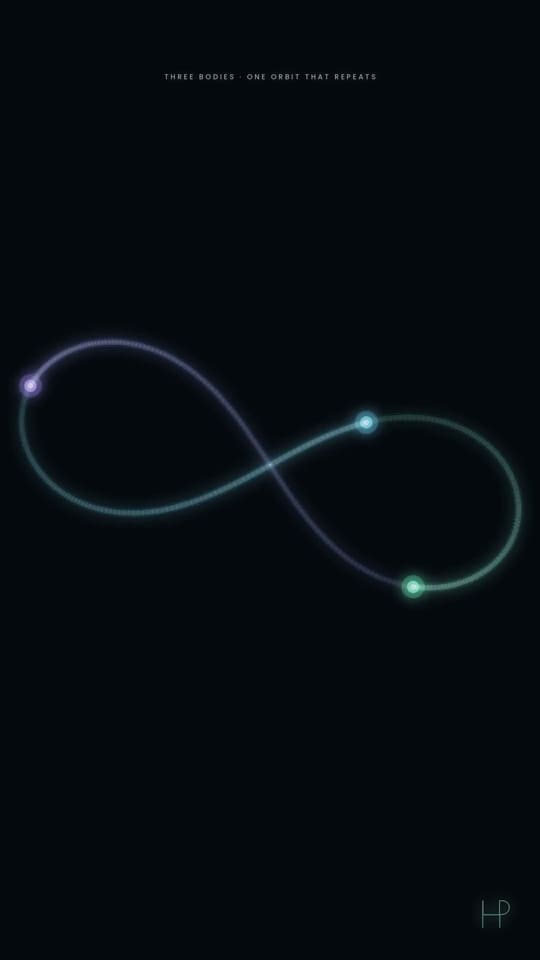
Três massas iguais, só gravidade. Quase todas as órbitas se desfazem; umas raras repetem-se para sempre.
É reproduzido a partir do YouTube depois de um clique.
Por que razão funciona
Dois corpos sob a gravidade giram um em torno do outro na mesma elipse para sempre. Junte um terceiro de massa igual e quase todas as condições iniciais acabam num emaranhado, normalmente com um corpo atirado para fora. Mesmo assim, umas raras condições iniciais fecham-se sobre si mesmas e repetem-se, como o oito.
aᵢ = G · Σⱼ≠ᵢ mⱼ · (rⱼ − rᵢ) ÷ |rⱼ − rᵢ|³para o oito: três massas iguais, momento angular nulo
Construa-o em Python
Python 3 · numpy · matplotlibO oito a partir dos seus valores iniciais publicados, três períodos em pequenos passos do método leapfrog.
"""Three bodies: the figure-eight orbit, from the starting values computed by Carles Simo
(in Chenciner and Montgomery, 2000). G = 1, three masses of 1.
Run: python three-body-orbits.py   (needs: pip install numpy matplotlib)
"""
import numpy as np
import matplotlib.pyplot as plt

plt.style.use("dark_background")

x1 = np.array([0.97000436, -0.24308753])
V = np.array([-0.93240737, -0.86473146])  # the velocity of body 3
pos = np.array([x1, -x1, [0.0, 0.0]])
vel = np.array([-V / 2, -V / 2, V])
period, dt = 6.32591398, 0.0005
turn = 0  # degrees to turn the first velocity by (the film breaks the eight with 15)

a = np.radians(turn)
vel[0] = [vel[0, 0] * np.cos(a) - vel[0, 1] * np.sin(a), vel[0, 0] * np.sin(a) + vel[0, 1] * np.cos(a)]


def pull(p):
    """Each body's acceleration: the sum of the other two's gravity, G*m / r**2 towards each"""
    acc = np.zeros_like(p)
    for i in range(3):
        for j in range(3):
            if i != j:
                d = p[j] - p[i]
                acc[i] += d / np.linalg.norm(d) ** 3
    return acc


track = []
acc = pull(pos)
for _ in range(int(3 * period / dt)):  # three periods, leapfrog steps (they keep the energy well)
    vel += acc * dt / 2
    pos += vel * dt
    acc = pull(pos)
    vel += acc * dt / 2
    track.append(pos.copy())
track = np.array(track)

colours = ["#5eead4", "#f0abfc", "#f5c76b"]
plt.figure(figsize=(7, 4))
for body in range(3):  # all three run along the same track, a third of a period apart
    plt.plot(track[:, body, 0], track[:, body, 1], color=colours[body], linewidth=1)
plt.scatter(track[-1, :, 0], track[-1, :, 1], c=colours, s=80, zorder=3)
plt.axis("equal")
plt.axis("off")
plt.show()

# Try: turn = 15 -> the three tracks no longer close; the eight falls apart
Experimente: Defina turn = 15, como no filme: as três trajetórias deixam de se fechar.
Aprenda este script linha a linha, com exercícios e um quiz → · execute-o no Google Colab (em inglês) →
A matemática, tal como o filme a conta
Ler as notas do próprio filme (do YouTube, em inglês)
Three equal masses pull on each other with nothing but Newton's gravity. For two bodies the motion is an ellipse, forever; for three there is no formula at all, and almost every start ends in a tangle — one body is usually flung away. Yet a handful of starting conditions close on themselves exactly.
The first act is the figure-eight, found numerically by Cris Moore in 1993 and proved to exist by Chenciner and Montgomery in 2000: three bodies chasing each other around one figure-eight track, always equally spaced in time. Then one body's velocity is nudged by 15 degrees. Nothing else changes, but the orbit is unstable to that nudge, so within seconds the ballet becomes chaos — and that is the normal state of three bodies.
From the chaos the film gathers them into two more of the periodic solutions catalogued by Šuvakov and Dmitrašinović in 2013, the "moth" and the "yin-yang", each broken again by the same nudge, before the figure-eight returns. Everything is integrated with an adaptive 8th-order method at relative tolerance 1e-9; the periodic orbits were checked to return to their starting state to about one part in a thousand after one period. The small white dot is the centre of mass — it never moves, because the total momentum is zero.
Da descrição de Three Bodies, Pure Gravity (em inglês).
Shorts
Fontes
- Three-body problem (Wikipedia)
- A. Chenciner, R. Montgomery, “A remarkable periodic solution of the three-body problem in the case of equal masses”, Annals of Mathematics 152 (2000)
- M. Šuvakov, V. Dmitrašinović, “Three classes of Newtonian three-body planar periodic orbits”, Physical Review Letters 110 (2013)