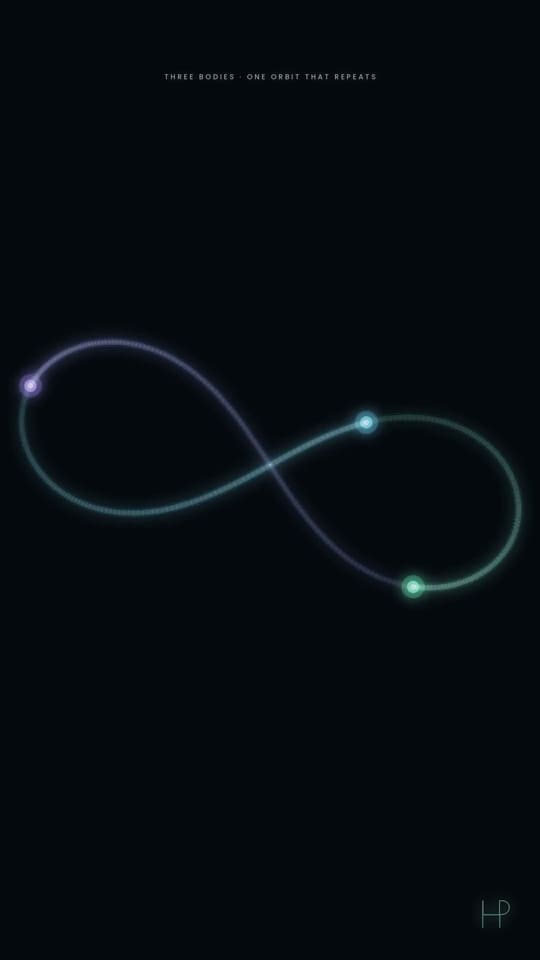
Three-body orbits
Three equal masses, only gravity. Almost every orbit breaks apart; a rare few repeat forever.
Plays from YouTube after a click.
A 2½-minute journey through the three-body problem. Headphones on.
The math
Three equal masses pull on each other with nothing but Newton's gravity. For two bodies the motion is an ellipse, forever; for three there is no formula at all, and almost every start ends in a tangle — one body is usually flung away. Yet a handful of starting conditions close on themselves exactly. The first act is the figure-eight, found numerically by Cris Moore in 1993 and proved to exist by Chenciner and Montgomery in 2000: three bodies chasing each other around one figure-eight track, always equally spaced in time. Then one body's velocity is nudged by 15 degrees. Nothing else changes, but the orbit is unstable to that nudge, so within seconds the ballet becomes chaos — and that is the normal state of three bodies. From the chaos the film gathers them into two more of the periodic solutions catalogued by Šuvakov and Dmitrašinović in 2013, the "moth" and the "yin-yang", each broken again by the same nudge, before the figure-eight returns. Everything is integrated with an adaptive 8th-order method at relative tolerance 1e-9; the periodic orbits were checked to return to their starting state to about one part in a thousand after one period. The small white dot is the centre of mass — it never moves, because the total momentum is zero.
From the description of Three Bodies, Pure Gravity.