Dlaczego obracanie pierścienia nic nie zmienia
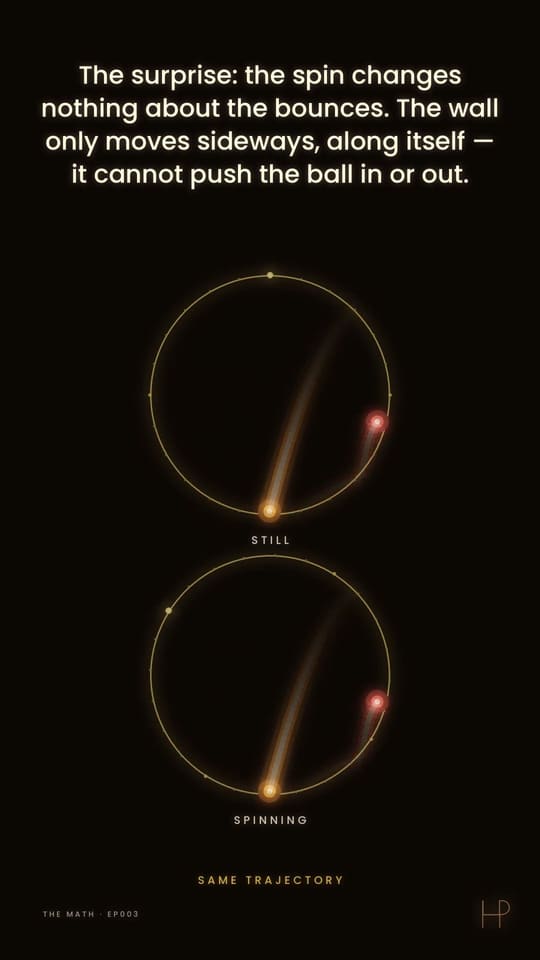
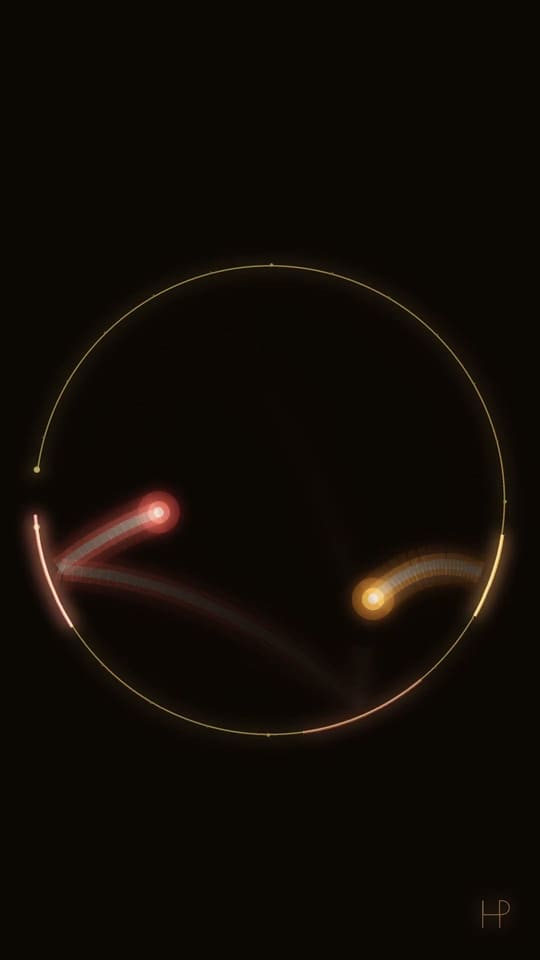
Kulki odbijają się w wirującym pierścieniu z rosnącą szczeliną. Obrót tylko przenosi szczelinę dookoła.
Film gra z YouTube po kliknięciu.
Dlaczego to działa
Kulki odbijają się w grawitacji wewnątrz pierścienia ze szczeliną, a pierścień się obraca. Można by się spodziewać, że obrót będzie nimi rzucał, ale wirujący pierścień bez tarcia odbija je dokładnie tak samo jak nieruchomy. Obrót tylko przesuwa obok nich szczelinę.
odbicie: v → v − 2·(v · n)·nściana porusza się wzdłuż t ⊥ n, więc (v · n) nie zależy od obrotu
Zbuduj to w Pythonie
Python 3 · numpy · matplotlibJedna kulka w grawitacji w pierścieniu, którego szczelina 18° obraca się raz na 4 sekundy, aż kulka ucieknie.
"""A ball under gravity in a ring with a gap that spins; the bounces are elastic and without friction.
Run: python spinning-ring.py   (needs: pip install numpy matplotlib)
"""
import numpy as np
import matplotlib.pyplot as plt

plt.style.use("dark_background")

R, ball, g = 1.0, 0.05, 9.81  # ring radius (m), ball radius, gravity
gap, spin = np.radians(18), 2 * np.pi / 4  # an 18 degree gap, one turn every 4 seconds
p, v = np.array([0.3, 0.2]), np.array([1.8, 0.7])
dt, t, track = 0.0005, 0.0, []

while t < 60:
    v[1] -= g * dt
    p = p + v * dt
    t += dt
    track.append(p.copy())
    r = np.linalg.norm(p)
    if r > R - ball:  # the ball touches the wall, or is at the gap
        angle = np.arctan2(p[1], p[0])
        centre = -np.pi / 2 + spin * t  # where the gap is now
        off = abs((angle - centre + np.pi) % (2 * np.pi) - np.pi)
        if off < gap / 2 - ball / R:  # all of the ball fits through: out
            break
        normal = p / r
        v = v - 2 * np.dot(v, normal) * normal  # the bounce: the spin plays no part in it
        p = normal * (R - ball)

track = np.array(track)
print(f"escaped after {t:.1f} s" if t < 60 else "still inside after 60 s")
plt.figure(figsize=(6, 6))
plt.plot(track[:, 0], track[:, 1], color="#5eead4", linewidth=0.4)
plt.gca().add_patch(plt.Circle((0, 0), R, fill=False, color="white"))
plt.axis("equal")
plt.axis("off")
plt.show()

# Try: spin = 0 and centre = -np.pi / 2 (a still gap at the bottom): the bounces stay the same
Spróbuj: Ustaw spin = 0 i przesuń szczelinę na dół: odbicia są takie same, zmienia się tylko droga na zewnątrz.
Poznaj ten skrypt linijka po linijce, z zadaniami i quizem → · uruchom go w Google Colab (po angielsku) →
Matematyka tak, jak opowiada ją film
Pokaż notatki z filmu (z YouTube, po angielsku)
Two balls bounce under gravity inside a circle that spins once every four bars of the music. Every bounce is perfectly elastic — no energy is lost, so the balls never calm down. One thing may surprise you: the spinning changes nothing about the bounces.
The wall of a rotating circle only ever moves sideways, along itself, so it cannot push a ball in or out; a frictionless spinning ring bounces exactly like a still one. The only thing the rotation does is carry the hole around — and because gravity keeps the balls near the bottom, their chances come each time the hole sweeps past the floor, once per revolution. The hole widens at the start of each round (8°, 12°, then 18°), and a ball only gets out if the whole of it fits through the gap at the moment it arrives.
The run you are watching was chosen from 500 simulated starting conditions for one reason: the first escape lands in the final seconds, and the other ball is still inside when the music ends.
Z opisu filmu Two Balls, One Growing Hole (po angielsku).