Por qué hacer girar el anillo no cambia nada
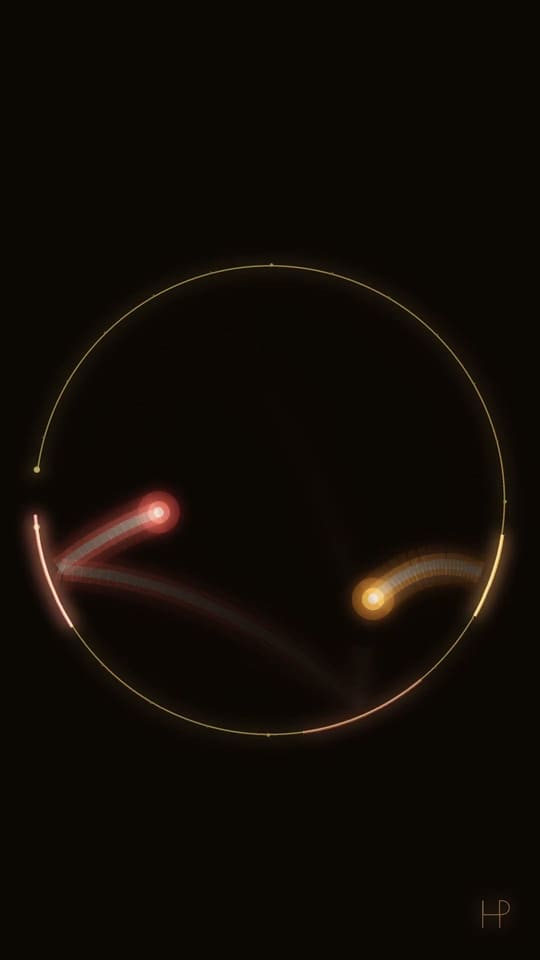
Unas bolas rebotan dentro de un anillo que gira, con una abertura que crece. El giro solo hace dar vueltas a la abertura.
Se reproduce desde YouTube tras hacer clic.
Por qué funciona
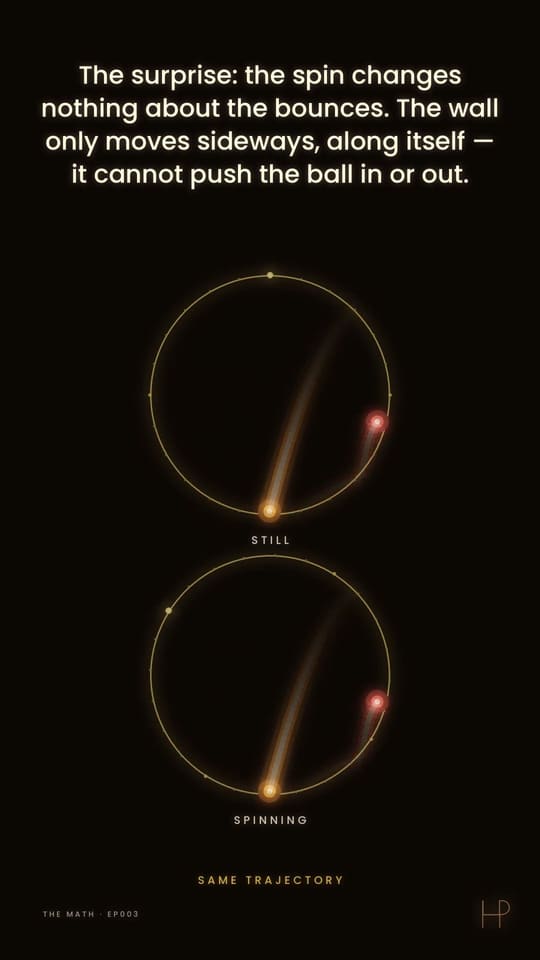
Unas bolas rebotan bajo la gravedad dentro de un anillo con una abertura, y el anillo gira. Podrías esperar que el giro lanzara las bolas de un lado a otro, pero un anillo giratorio sin rozamiento las hace rebotar exactamente igual que uno quieto. Lo único que hace el giro es pasear la abertura por delante de ellas.
rebote: v → v − 2·(v · n)·nla pared se mueve a lo largo de t ⊥ n, así que a (v · n) no le afecta el giro
Constrúyelo tú
Python 3 · numpy · matplotlibUna bola bajo la gravedad en un anillo cuya abertura de 18° da una vuelta cada 4 segundos, hasta que escapa.
"""A ball under gravity in a ring with a gap that spins; the bounces are elastic and without friction.
Run: python spinning-ring.py   (needs: pip install numpy matplotlib)
"""
import numpy as np
import matplotlib.pyplot as plt

plt.style.use("dark_background")

R, ball, g = 1.0, 0.05, 9.81  # ring radius (m), ball radius, gravity
gap, spin = np.radians(18), 2 * np.pi / 4  # an 18 degree gap, one turn every 4 seconds
p, v = np.array([0.3, 0.2]), np.array([1.8, 0.7])
dt, t, track = 0.0005, 0.0, []

while t < 60:
    v[1] -= g * dt
    p = p + v * dt
    t += dt
    track.append(p.copy())
    r = np.linalg.norm(p)
    if r > R - ball:  # the ball touches the wall, or is at the gap
        angle = np.arctan2(p[1], p[0])
        centre = -np.pi / 2 + spin * t  # where the gap is now
        off = abs((angle - centre + np.pi) % (2 * np.pi) - np.pi)
        if off < gap / 2 - ball / R:  # all of the ball fits through: out
            break
        normal = p / r
        v = v - 2 * np.dot(v, normal) * normal  # the bounce: the spin plays no part in it
        p = normal * (R - ball)

track = np.array(track)
print(f"escaped after {t:.1f} s" if t < 60 else "still inside after 60 s")
plt.figure(figsize=(6, 6))
plt.plot(track[:, 0], track[:, 1], color="#5eead4", linewidth=0.4)
plt.gca().add_patch(plt.Circle((0, 0), R, fill=False, color="white"))
plt.axis("equal")
plt.axis("off")
plt.show()

# Try: spin = 0 and centre = -np.pi / 2 (a still gap at the bottom): the bounces stay the same
Prueba: Pon spin = 0 y lleva la abertura a la parte inferior: los rebotes siguen igual, solo cambia la salida.
Aprende este script línea a línea, con ejercicios y un cuestionario → · ejecútalo en Google Colab (en inglés) →
Las matemáticas, tal como las cuenta el vídeo
Lee las notas del propio vídeo (de YouTube, en inglés)
Two balls bounce under gravity inside a circle that spins once every four bars of the music. Every bounce is perfectly elastic — no energy is lost, so the balls never calm down. One thing may surprise you: the spinning changes nothing about the bounces.
The wall of a rotating circle only ever moves sideways, along itself, so it cannot push a ball in or out; a frictionless spinning ring bounces exactly like a still one. The only thing the rotation does is carry the hole around — and because gravity keeps the balls near the bottom, their chances come each time the hole sweeps past the floor, once per revolution. The hole widens at the start of each round (8°, 12°, then 18°), and a ball only gets out if the whole of it fits through the gap at the moment it arrives.
The run you are watching was chosen from 500 simulated starting conditions for one reason: the first escape lands in the final seconds, and the other ball is still inside when the music ends.
De la descripción de Two Balls, One Growing Hole (en inglés).