Plays from YouTube after a click.
Pure Randomness Draws a Perfect Fractal
A 2½-minute journey through the chaos game. Headphones on.
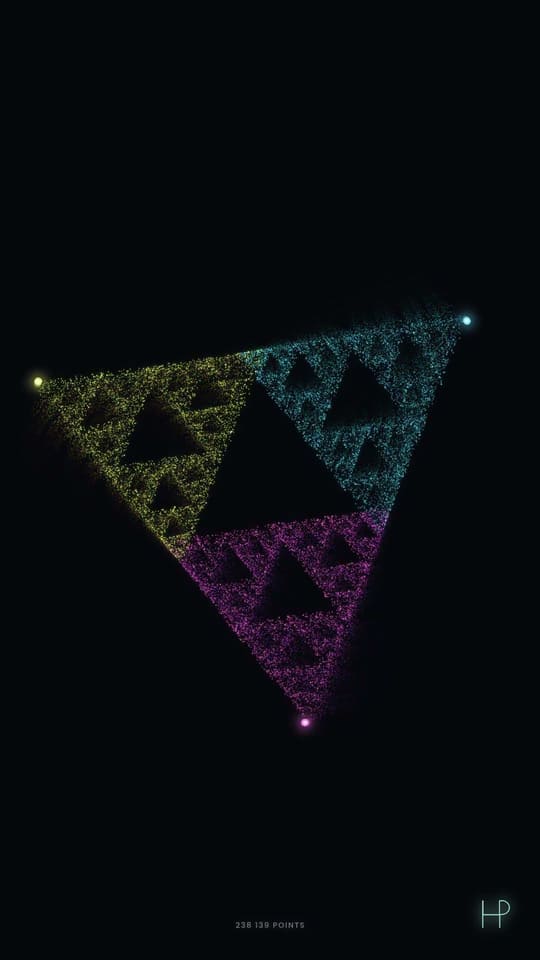
Focus with this filmJump halfway to a random corner, again and again. A perfect fractal appears out of pure chance.
All about the chaos game →The math
Start anywhere. Pick one of the triangle's three corners at random and jump exactly halfway toward it. Plot the point. Repeat. Nothing about the choices is planned — a coin, a die, pure chance — and yet after a few thousand jumps the Sierpiński triangle appears, sharp and complete. The reason is that "jump halfway to a corner" is a contraction: it shrinks every distance by half, so wherever the point starts, after a handful of jumps it is pulled onto the one shape that the three half-size copies of itself map back onto — the fractal is the only set the rule leaves unchanged. Each point here is coloured by the corner it just jumped toward, which is why order seems to grow out of rainbow noise. From the triangle on, only the rule changes: a pentagon with a golden jump of 0.618, a pentagon where the same corner may never be chosen twice in a row, a square where the opposite corner is forbidden, a hexagon with a two-thirds jump. Every new shape is born from the cloud of the previous one, because the walkers simply keep going under the new rule. Nothing is drawn; everything is counted.